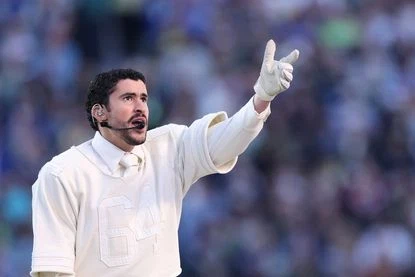
If you spent any time on social media following Super Bowl LX, you likely encountered a digital battlefield. The 2026 halftime show featuring Bad Bunny (Benito Antonio Martínez Ocasio) didn’t just trend; it ignited a full-scale “outrage ecosystem.” In a world where viral behavior is the currency of the day, being the most-talked-about person on the planet often comes with a side of intense, unfiltered fury.
The backlash to Benito’s set at Levi’s Stadium was swift, organized, and deeply reflective of the polarized state of 2026. This wasn’t just a debate about music; it was a collision of competing visions for what “America” should look and sound like.
The Language Barrier as a Cultural Frontline
The most immediate source of anger for a vocal segment of the audience was the language. Bad Bunny made history as the first solo artist to perform a Super Bowl halftime set almost entirely in Spanish. For many, this was seen as a “slap in the face” to English-speaking Americans.
- The “Unintelligible” Argument: High-profile critics, including President Donald Trump, took to Truth Social to claim that “nobody understands a word this guy is saying.” The choice to perform in Spanish was framed not as an act of cultural pride, but as an act of exclusion.
- The SNL Prophecy: Fans were quick to point back to Benito’s 2025 Saturday Night Live appearance, where he told viewers they had “four months to learn Spanish” before the Super Bowl. What he intended as a playful challenge was interpreted by his detractors as a smug dismissal of traditional American norms.
The “ICE Out” Activism
The fury was further stoked by Bad Bunny’s overt political stances. Just a week prior at the 2026 Grammys, he ended his acceptance speech with a defiant “ICE out!”—a direct jab at the administration’s immigration policies.
While he didn’t repeat the phrase during the halftime show, the performance was riddled with what critics called “woke” symbolism. From dancers climbing “fizzling” electricity pylons—a nod to Puerto Rico’s power grid failures—to the prominent display of the Puerto Rican independence flag, the set was viewed by the Right as a “political stunt” funded by the NFL. The fact that he bypassed the U.S. leg of his recent tour to “protect fans from ICE” only added to the narrative that he “hates America.”
The Battle of the Halftime Shows
The outrage was so concentrated that it birthed its own counter-culture event. Turning Point USA hosted an “All-American Halftime Show” simultaneously, featuring Kid Rock and Lee Brice. This alternative broadcast drew over five million viewers, serving as a digital clubhouse for those who felt “alienated” by the official show.
On X and TikTok, the “disgusting dancing” (a term popularized by the President’s critique) became a viral flashpoint. Clips of perreo—the heavy-grinding dance style synonymous with reggaeton—were labeled as “inappropriate for children” and “foreign.” The satire machine went into overdrive, with AI-generated images of burning American flags (which never happened) being shared as “evidence” of the show’s anti-American sentiment.
Why the Outrage Thrives
In 2026, the outrage ecosystem doesn’t need facts to thrive; it needs arousal. The fury surrounding Bad Bunny is profitable for the “Outrage Economy.” Every angry tweet, every boycott call, and every “reaction video” fuels the very visibility that both the artist and his critics crave.
The truth is that while 29% of the country may have disapproved of the show, it was also the most-watched halftime performance in history, with 135.4 million viewers. The fury isn’t a sign of failure; in the modern pop culture cycle, it’s a sign of absolute dominance. We are furious because we are paying attention—and in 2026, that is the only thing that matters.
Leave a Reply