There was a time when a celebrity appearance had a beginning and an end. A star walked a red carpet, gave an interview, attended a premiere or performed onstage, and eventually the event faded into the background. Today, that ending rarely arrives. Instead, the appearance becomes the beginning of another conversation. Someone posts a photograph. Someone else notices a detail. A fan creates a theory. A critic responds. Another account reposts the reaction. Entertainment outlets begin covering the online discussion, and suddenly the original moment has become an entirely different story. The internet has once again entered its favorite phase: “We need to discuss this.”
The phrase captures something increasingly familiar about online culture. There does not always have to be a major scandal for the internet to mobilize. Sometimes all it takes is a celebrity wearing an unexpected outfit, making an unusual facial expression, appearing beside another famous person, saying something during an interview, or posting a few words online. The audience fills in the gaps, and those interpretations can become more interesting than the original event itself. Celebrity culture now operates as a continuous feedback loop in which the audience is not merely consuming entertainment news but actively creating it.
The beginning of October 2026 offered plenty of examples. Paris Fashion Week brought an enormous collection of celebrities into the same physical spaces, from Jennifer Lopez and Rihanna to Heidi Klum, Janelle Monáe, Paris Jackson and many others. Their appearances were photographed and published almost immediately, but the conversation did not stop with the clothes or the shows. Every image became an opportunity for audiences to compare looks, discuss styling choices, identify relationships and debate who had the most memorable appearance. PEOPLE’s October 4 celebrity roundup showed just how densely packed the week was with stars, fashion events, premieres and performances.
This is one of the defining characteristics of modern celebrity culture: the event is only the first layer. The second layer is the reaction. The third layer is the reaction to the reaction. By the time the original celebrity has moved on to the next appearance, the internet may still be analyzing what happened. A red-carpet outfit becomes a fashion debate. A celebrity interaction becomes a relationship theory. A joke becomes a meme. A serious statement becomes a political or cultural conversation. The original moment keeps producing new versions of itself.
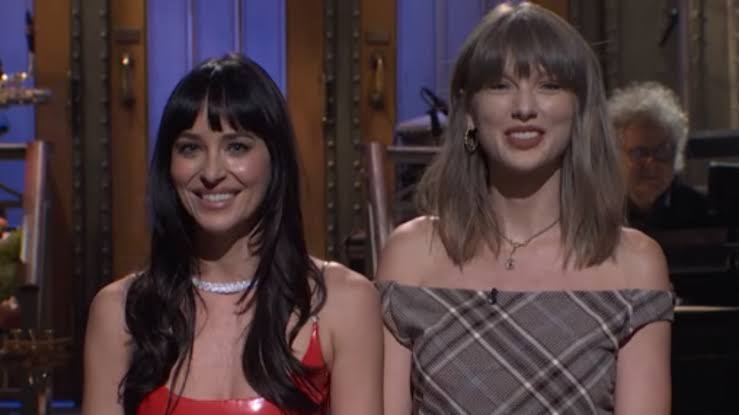
Taylor Swift’s surprise appearance alongside Dakota Johnson on Saturday Night Live provided a perfect example of how quickly an entertainment moment can become social-media material. Swift appeared during Johnson’s monologue as a joking “therapist,” and the unexpected cameo immediately became one of the most discussed parts of the episode. Variety reported that Swift’s appearance had been heavily anticipated by some viewers and that the moment included an additional Travis Kelce reference that gave fans another detail to dissect.
The important part is not simply that Swift appeared. It is that the appearance contained multiple elements designed to travel beyond the original broadcast. There was the surprise itself, the Swift-Johnson friendship dynamic, the joke, the Travis Kelce reference, the birthday connection and the fact that Swift had already appeared in another high-profile television context recently. Each element offered audiences a different reason to talk. One appearance effectively generated several possible stories.
That is how the feedback loop works. Celebrities provide the initial material, but audiences determine what survives. A two-minute television appearance can become a dozen social posts. A photograph can inspire hundreds of comments. A single sentence can be clipped and viewed without the rest of the interview. Once something enters the social-media ecosystem, it no longer belongs entirely to the person who created it.
Sometimes that process is harmless and funny. Fans turn an awkward moment into a meme. A celebrity’s unusual outfit becomes a running joke. Two famous friends share a look and the internet invents an entire imaginary conversation. These moments can actually strengthen a celebrity’s relationship with their audience because participation feels communal. People are not simply watching; they are collectively interpreting.
Other times, however, the conversation becomes much more serious.
Florence Pugh’s recent social-media posts about the Cornell sexual-assault case demonstrate how quickly a celebrity’s decision to speak publicly can create a much larger discussion. Pugh used her platform to express outrage over the allegations and the institutional response described in reporting surrounding the case. Her posts then became part of a broader Hollywood conversation, with other celebrities including Mariska Hargitay and Josh Gad also publicly responding. Variety reported that Pugh subsequently discussed the issue on The View and criticized Instagram after one of her posts received a content warning.
This is a different kind of feedback loop, but the underlying mechanism is similar. A celebrity makes a statement. Audiences react. Other public figures respond. Media outlets cover the reactions. The new coverage brings more people into the conversation, producing another round of commentary. The story grows not because one new event necessarily occurred, but because the reaction itself became news.
That distinction is increasingly important. The internet has created a media environment in which the reaction to an event can become just as significant as the event itself. A celebrity does not need to release new information for the story to continue. Sometimes the only development is that more people have responded.
Social media also encourages people to look for meaning in tiny details. A celebrity may post a photograph that seems completely ordinary, but fans immediately begin examining the background, the caption, the clothing, the timing and even who liked the post. The culture of celebrity observation has become remarkably granular. People are no longer just asking, “What did this celebrity do?” They are asking, “Why did they do it this way?”
That question is what keeps the cycle alive.
The rise of short-form video has accelerated the process even further. A long interview can now be reduced to a ten-second clip. A three-hour event can become one facial expression. A complicated statement can be transformed into a sentence that loses its original context. Once a clip begins circulating, the audience often encounters the reaction before it encounters the source material. People may learn what they are supposed to think about a moment before they have actually seen the entire moment.
That creates a strange form of celebrity storytelling where context becomes optional. The internet is extraordinarily good at turning fragments into narratives. Sometimes the narrative is accurate. Sometimes it is exaggerated. Sometimes it is completely wrong. But once enough people begin repeating it, the distinction between what actually happened and what the internet thinks happened can become surprisingly difficult to maintain.
The celebrity therefore becomes both participant and subject. They can post something to control their own narrative, only to discover that the post itself becomes the new story. They can clarify a misunderstanding and accidentally create another headline. They can respond to criticism and give the criticism another day of life. They can remain silent and have that silence interpreted as meaningful.
There is almost no neutral position anymore.
The recent reaction surrounding Sydney Sweeney’s advertising campaign illustrated how quickly commercial celebrity appearances can enter the same cycle. A sports-betting advertisement featuring Sweeney generated criticism from athletes who argued that the campaign sexualized women in sport. Their responses on social media then became part of the coverage, transforming an advertising campaign into a wider cultural debate.
Again, the advertisement itself was only the starting point. The second story was the backlash. The third story was the response to the backlash. The internet does not simply consume a piece of celebrity marketing anymore; it interrogates it, argues with it, remixes it and sometimes turns it into something completely different.
This is why celebrity culture can feel exhausting even when nothing particularly dramatic is happening. There is always another conversation waiting to begin. A star attends a fashion show, and within minutes people are discussing the outfit. The same star attends a premiere two days later, and the audience is comparing the two appearances. A photograph is posted, and people start speculating about what happened before or after it was taken. An interview clip goes viral, and suddenly an old quote resurfaces for comparison.
The past is always available to the present.
That may be one of the biggest reasons celebrities seem to generate more controversy than ever. The internet has an enormous memory. Old interviews, photographs, tweets, videos and statements can return at any time. A celebrity’s current appearance can trigger a search through their previous behavior, and a new story can emerge from something that happened years ago. The conversation is never truly starting from zero.
Yet the constant discussion is not necessarily bad for celebrities. Attention remains attention, and attention can be incredibly valuable. A star who becomes the subject of widespread discussion may see increased interest in their projects, social accounts, fashion partnerships or brand collaborations. Even criticism can increase visibility. The internet does not always distinguish between positive and negative engagement when measuring what deserves to be seen next.
That creates one of the strangest incentives in modern celebrity culture: being discussed can sometimes matter more than being universally liked.
A celebrity who creates no reaction may disappear from the daily conversation. A celebrity who generates strong reactions can remain culturally relevant for weeks. This does not mean controversy is always intentional, but it explains why polarizing figures can maintain enormous online visibility. Audiences may complain about them while continuing to watch, share and discuss them.
The feedback loop therefore has an economic dimension. Attention produces engagement. Engagement produces visibility. Visibility produces more coverage. Coverage produces more discussion. Discussion sends more people back to the original content. The cycle repeats.
And audiences are not passive participants in that system. Every comment, repost, quote-post, reaction video and search contributes to it. Even saying “Why are we talking about this?” can help keep the topic alive. The internet’s favorite form of criticism can therefore become accidental promotion.
This is especially obvious during major cultural events. Paris Fashion Week, awards shows, movie premieres and television premieres create concentrated bursts of celebrity activity. Instead of one headline dominating the conversation, dozens of small moments compete simultaneously. Audiences choose favorites, create rankings, argue over fashion, compare celebrity interactions and decide which moments deserve to become memes. The event becomes a giant social-media conversation rather than a single entertainment story.
The result is a celebrity culture that increasingly resembles a collaborative reality show. The stars provide the footage. The media provides the framing. Fans provide the commentary. Critics provide the counterargument. Algorithms decide which conversations receive more visibility. Then everyone reacts to everyone else.
And just when the internet appears ready to move on, somebody posts one more thing.
That is why the phrase “we need to discuss this” feels so appropriate to the current moment. It is rarely literally necessary to discuss every celebrity outfit, every awkward interview, every relationship rumor or every viral clip. But the internet has transformed discussion itself into entertainment. People enjoy analyzing famous people because it gives them a shared cultural language. Everyone can have an opinion. Everyone can participate. Everyone can add one more observation to an already enormous conversation.
The real story, then, may not be that celebrities are constantly doing extraordinary things. It is that the internet has become extraordinarily good at turning ordinary moments into events.
A celebrity walks into a restaurant. Someone photographs it.
A celebrity attends a fashion show. Someone analyzes the outfit.
A celebrity makes a joke. Someone clips it.
A celebrity responds to criticism. Someone critiques the response.
A celebrity says nothing. Someone asks why.
And suddenly there is another headline.
That cycle is unlikely to disappear anytime soon. If anything, the combination of celebrity culture, short-form video, instant publishing and algorithm-driven discovery will make the feedback loop even faster. The distance between an event and its reaction is becoming almost nonexistent. By the time a celebrity realizes something has gone viral, the internet may already be discussing the next layer of the story.
So yes, the internet has entered its “we need to discuss this” era again.
But perhaps it never really left.
Caption: The celebrity moment is only the beginning. The internet always has something to say next.
References
PEOPLE — Celebrity Star Tracks, October 4, 2026
Variety — Taylor Swift Crashes Dakota Johnson’s SNL Monologue
Variety — Florence Pugh Speaks Out Over the Cornell University Case
Variety — Mariska Hargitay and Other Celebrities Speak Out
Variety — Florence Pugh Discusses Instagram and Her Social-Media Posts
Variety — Sydney Sweeney Advertisement Sparks Online Backlash
PEOPLE — Celebrity Sightings and Events Across New York and Paris
Leave a Reply